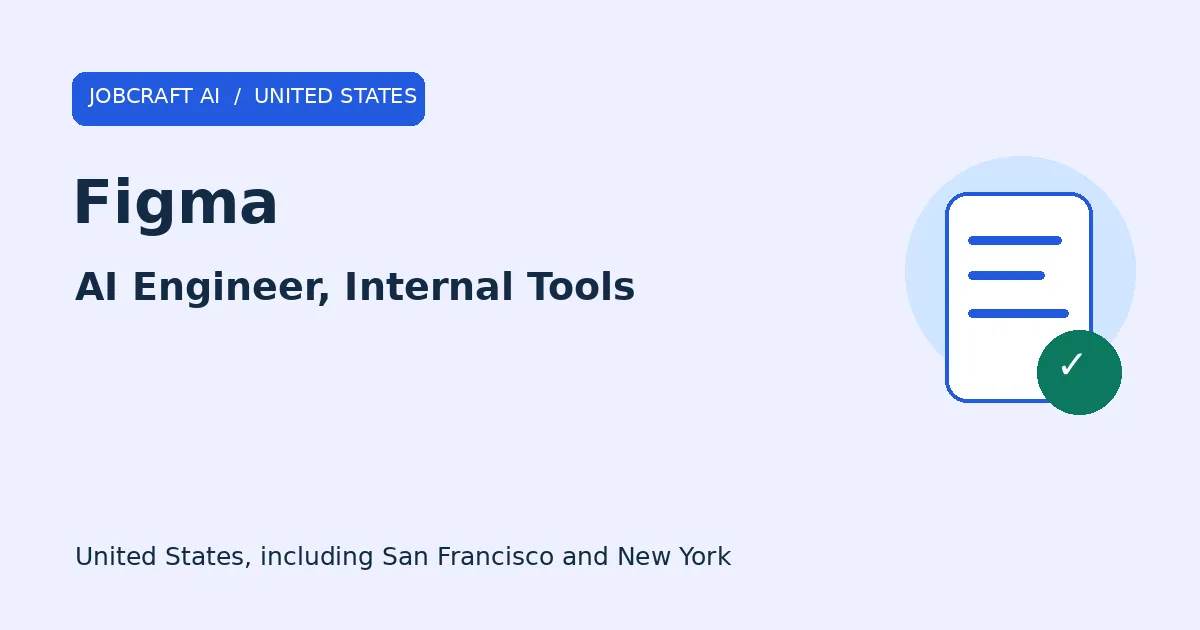
Location: United States, including San Francisco and New York. Employer listing checked: November 14, 2026.
Figma’s AI Engineer, Internal Tools opening is listed as a full-time role in its US hubs or remotely within the United States. The Internal AI team works with business functions such as sales, support, finance, people, and legal. The Applied AI Builds position takes workflows from discovery and prototype to evaluation and production. Figma lists at least five years of software engineering experience and mentions integrations, retrieval, structured outputs, evaluations, and controls for consequential actions.
Show why the workflow needs the proposed approach
A project can sound valuable when a demo answers one question accurately. Before building, define who needs the capability, the inputs it will receive, and what mistakes are costly. Compare a rule-based solution, a search tool, and a model-assisted workflow. In some cases, a predictable filter or lookup can solve most of the problem. Describe how you decided which portions required language understanding and which would benefit from explicit rules.
A résumé example should show your path from discovery to a production decision. Explain the original workflow, how you observed the pain point, and what acceptance criteria your team agreed on. Distinguish your contribution from those of the product, data, and infrastructure partners. Mention techniques such as retrieval or tool calling only where you used them and can explain why.
Prepare an evaluation plan
Suppose an internal assistant drafts answers from approved reference materials. Build a test set that includes routine questions, outdated references, ambiguous wording, and requests that should be handed to a human. Define the expected behavior for each. Track errors by category so a strong average cannot conceal poor performance on questions that matter most.
Explain how you would verify changes before rollout and monitor what happens afterward. A change in retrieval may improve one group of answers while hurting another. Keep the baseline visible and collect enough context to reproduce a failure without logging unnecessary sensitive information. Demonstrate how an evaluation result influenced a product decision.
Discuss safe integration and ownership
If a workflow can update a record, describe how the application checks authority, which actions require review, and how a user can see what was attempted. Include what happens when an integration is unavailable or returns an unexpected result. An internal tool should have an owner who can investigate issues and stop an unreliable workflow while the team works on a fix.
Choose one project that shows you supported a system after launch. Prepare to discuss what you measured, what users reported, and how you prioritized improvements. If you mainly have backend or integrations experience, make the transferable evidence concrete. A small pilot with careful testing and documented limits can show more about your judgment than a long list of frameworks.
What to bring to your application
Start with an internal workflow where evaluation guided the choice to launch or revise a tool. Draft three sentences before writing a résumé bullet. The first explains the problem in language a colleague outside your team would understand. The second states the decision you owned and why you chose it. The third gives the result and identifies what you know firsthand. If the outcome came from several people, say which part you can explain in detail. This exercise helps turn a broad claim into evidence you can discuss if the employer asks follow-up questions.
For this opening, consider preparing a small evaluation record with expected behavior and observed failure categories. You may use it to organize your interview answer even if you never send it. Include only information you are allowed to share. Replacing company names is insufficient if a chart or a unique deal detail still identifies the organization. A reconstructed example with synthetic data can show the process if you label it clearly and avoid presenting its figures as a past result. Give each entry a short caption that explains the decision it supported.
A practice question for this opening
Practice question: How would you prove a model-assisted workflow is ready for production?
An internal assistant summarizes a policy, but two approved references disagree because one is outdated. Describe the expected behavior when source freshness cannot be established. Design a test that checks whether the system cites the current material or asks for review. Include who would own the correction and what evidence would support expanding the rollout. The exercise should demonstrate product judgment as well as engineering skill.
Build a second answer from your own work or studies. A useful starting point is a situation where test coverage showed routine answers were good while important edge cases were unreliable. Explain what made the situation difficult and what information you had at the time. Then describe your reasoning, including whether an action like staging rollout while adding explicit review for cases with higher consequences would have made sense. If you made a different choice, explain the constraints. The goal is to show how you evaluate alternatives, make a decision, and learn from the result. A mixed outcome can be useful if you can account for it honestly.
To prepare follow-ups, review the test dataset design, launch criteria, and anonymized operational feedback. Think about what each piece would verify. Interviewers can ask how you established the baseline, what happened when an assumption changed, or how you knew the project worked. If you do not have reliable numbers, identify something observable you can explain, such as a completed handoff, a passed test, or a change in the expected workflow. Keep a clear distinction between the facts you observed and the conclusions you drew from them.
What to clarify before applying
One question to ask the employer is: “How does Applied AI Builds decide between a team-specific tool and a reusable platform component?” Listen for an answer that gives examples, such as the first assignment, the people who will review your work, or the outcomes measured during onboarding. Make a note of anything the listing leaves open about location, work arrangements, availability, or the scope of the position. A written requirement on the official posting deserves more weight than an assumption based on the title alone.
Before submitting, read through the application as if you were the reviewer. Put the most relevant evidence where it can be found quickly. Check that job titles and dates agree across your résumé and application, that every link works without credentials, and that the selected draft names Figma correctly. Use the JobCraft AI résumé checker to review your document against the full posting, then make edits based on work you can demonstrate.
Official listing and application
Confirm the opening is still listed and follow the employer’s submission instructions. View the job and apply through Figma