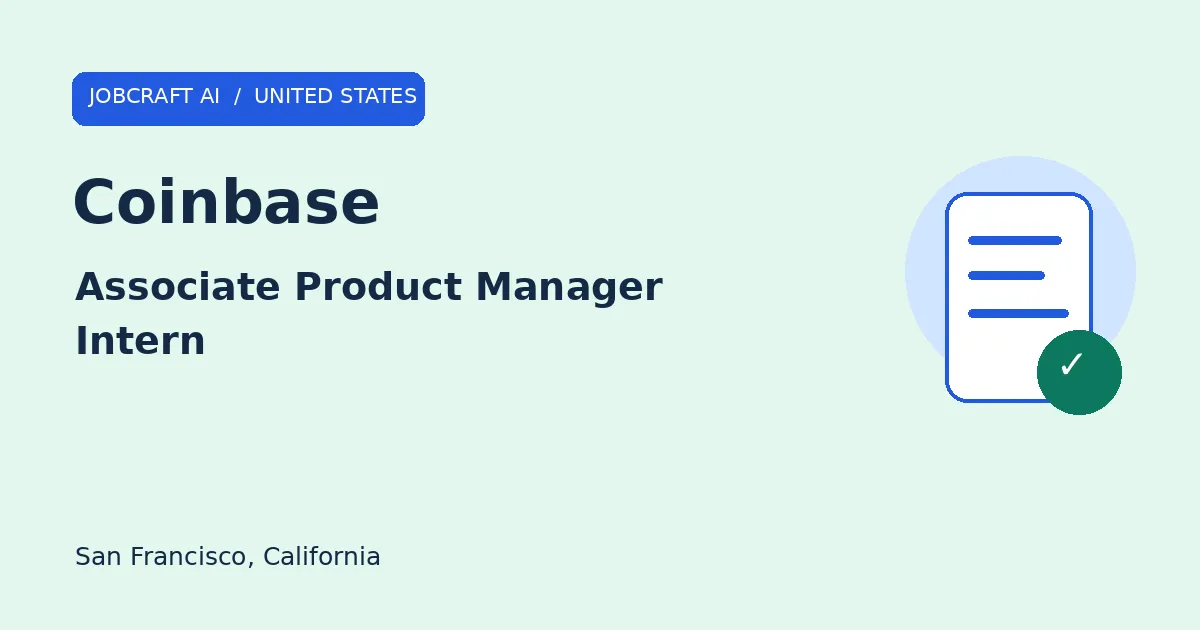
Location: San Francisco, California. Employer listing checked: November 14, 2026.
Coinbase lists a hybrid San Francisco Associate Product Manager internship for summer 2027. The posting describes a 12-week program in which interns define requirements, work alongside engineering and design, gather user feedback, and measure a launch. It lists a $55 USD target hourly rate for the role and asks for project or internship evidence in product management, design, or related technical work.
Translate the job description into a portfolio
An internship portfolio can include class projects, hackathons, student organizations, or personal work. Choose a project where you can explain why a feature was worth building. The strongest example starts with a problem, states what you learned from users or data, and shows an actual change you helped ship. If a project stopped at a prototype, label it as such and describe what the prototype helped you learn.
The posting asks for experience with cryptocurrency or blockchain through coursework, projects, internships, or participation in the ecosystem. You can show that with a concrete topic you understand, such as how a user confirms a transaction, how a wallet recovery flow works at a conceptual level, or what helps users understand network fees. Focus on the product problem and keep any financial claims out of the project unless you can support them.
Design a small product experiment
Suppose first-time users stop halfway through a setup flow. Before proposing a feature, identify where they leave, which device or user group is affected, and whether the event data supports that conclusion. Talk to a few users if feasible. A confusing request for information and an unexpected technical error require different solutions.
Pick one change that would make the flow easier to understand. Define a primary success measure, such as completion among eligible new users, and a guardrail like support contacts or errors. Describe how you would inspect the results and how you would decide to revert or iterate. A classroom or prototype project can show the same reasoning even if you lack live experiment data.
Practice a cross-functional conversation
Imagine design wants a simpler first screen, engineering discovers a dependency will take longer than expected, and a compliance partner needs a piece of information before users continue. Outline what is fixed and what can move. Explain how you would document the requirement and propose a narrower release. Prepare to describe whose input changed your decision and how you told the rest of the team.
For your résumé, a concise bullet can name the audience, the action you took, and the observed result. Product discovery, launch metrics, user research, and A/B testing are useful phrases only when your project involved them. If you used an AI tool, explain what you verified yourself and how that affected the quality of the deliverable.
Check the program details before submission
The employer lists San Francisco for this opening and also describes different locations within its broader internship program. Follow the location on the application you actually submit. The listing mentions a limit of three applications in six months, so review the company’s current instructions before using a slot.
Build an application around evidence the reader can verify
Start with a small product launch you helped define and ship. Draft three sentences before writing a résumé bullet. The first explains the problem in language a colleague outside your team would understand. The second states the decision you owned and why you chose it. The third gives the result and identifies what you know firsthand. If the outcome came from several people, say which part you can explain in detail. This exercise helps turn a broad claim into evidence you can discuss if the employer asks follow-up questions.
For this opening, consider preparing a brief with a user problem, proposed scope, release criteria, and a metric. You may use it to organize your interview answer even if you never send it. Include only information you are allowed to share. Replacing company names is insufficient if a chart or a unique deal detail still identifies the organization. A reconstructed example with synthetic data can show the process if you label it clearly and avoid presenting its figures as a past result. Give each entry a short caption that explains the decision it supported.
Review your story against completion rates, error types, interview notes, and implementation constraints. Decide which facts are essential to understanding the work and which are background. A useful test is to describe your role in one minute, then ask someone to repeat back the problem, your contribution, and the outcome. Revise any part they cannot follow. After that, prepare a longer version that makes room for constraints and trade-offs without obscuring the main point.
Interview practice with a role-specific prompt
Practice question: What would you do if a feature shipped on time but adoption stayed low?
Imagine a dashboard shows sign-ups increasing, but new users rarely finish the first meaningful task. Define a cohort and a point of success before looking at the data. Propose user research to distinguish uncertainty from a technical error. Explain when the evidence would support rewriting guidance, changing a flow, or fixing an underlying reliability issue.
Build a second answer from your own work or studies. A useful starting point is a situation where you learned that a confusing first screen mattered more than a feature users requested. Explain what made the situation difficult and what information you had at the time. Then describe your reasoning, including whether an action like testing a smaller change that removed ambiguity at the point of abandonment would have made sense. If you made a different choice, explain the constraints. The goal is to show how you evaluate alternatives, make a decision, and learn from the result. A mixed outcome can be useful if you can account for it honestly.
To prepare follow-ups, review a prototype, decision notes, and the results or limitations of your test. Think about what each piece would verify. Interviewers can ask how you established the baseline, what happened when an assumption changed, or how you knew the project worked. If you do not have reliable numbers, identify something observable you can explain, such as a completed handoff, a passed test, or a change in the expected workflow. Keep a clear distinction between the facts you observed and the conclusions you drew from them.
Decide whether the opening fits your priorities
One question to ask the employer is: “How are intern projects scoped so the intern can see the results of a release?” Listen for an answer that gives examples, such as the first assignment, the people who will review your work, or the outcomes measured during onboarding. Make a note of anything the listing leaves open about location, work arrangements, availability, or the scope of the position. A written requirement on the official posting deserves more weight than an assumption based on the title alone.
Before submitting, read through the application as if you were the reviewer. Put the most relevant evidence where it can be found quickly. Check that job titles and dates agree across your résumé and application, that every link works without credentials, and that the selected draft names Coinbase correctly. Use the JobCraft AI résumé checker to review your document against the full posting, then make edits based on work you can demonstrate.
Official listing and application
Confirm the opening is still listed and follow the employer’s submission instructions. View the job and apply through Coinbase