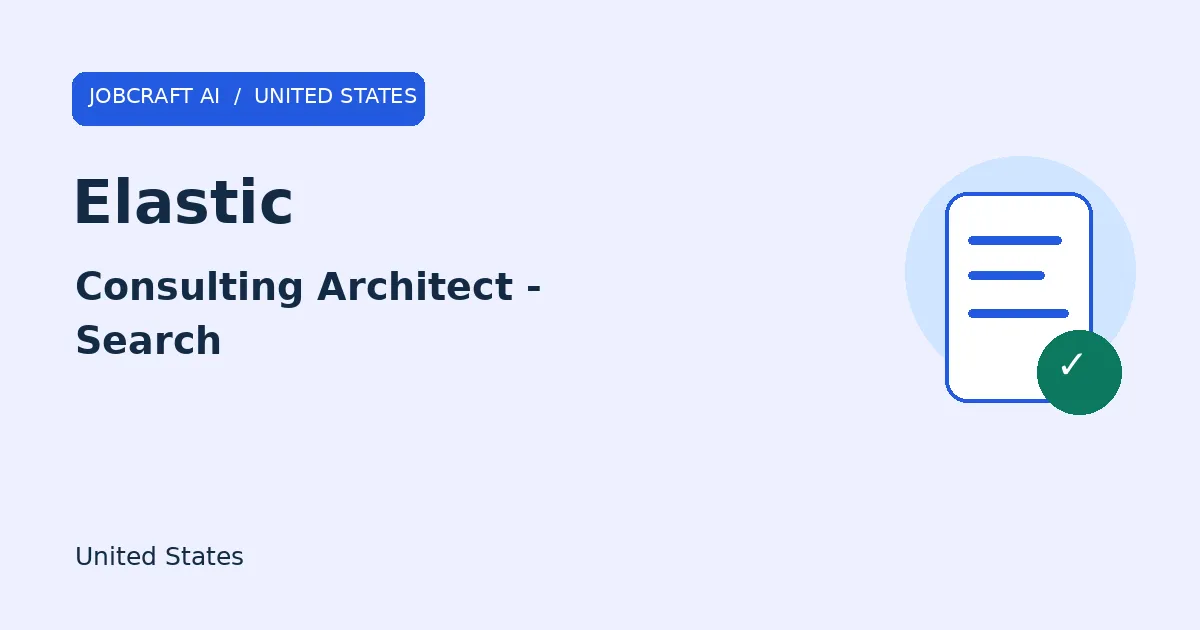
Location: United States. Employer listing checked: November 14, 2026.
Elastic’s US Consulting Architect – Search opening is an enterprise-facing position focused on large Elasticsearch deployments. The posting calls for at least five years in a relevant consulting or senior engineering role with deep Elasticsearch expertise. It covers cluster architecture, large migrations, performance tuning, and production semantic search, with a substantial advisory component.
Distinguish search architecture from a search demo
A demo can show that a query returns interesting results. An enterprise design also has to cope with changing document volumes, uneven traffic, indexing bursts, security boundaries, and the cost of maintaining the service. A strong case study explains how business constraints affected index mappings, shard strategy, indexing rates, and capacity. Include the measures you used to decide when to tune the design or change it.
The employer names Lucene mechanics, lifecycle management, distributed scaling, vector search, and hybrid retrieval. Those topics fit together when a team can explain which requirement each choice addresses. Search freshness, latency, cost, disaster recovery, and relevance can pull in different directions. Show how you made those priorities explicit to the customer rather than starting from a favorite topology.
Prepare a migration case study
Pick a migration that had a clear reason for taking place, such as replacing an index strategy that could no longer keep up with ingestion. Describe the old workload in terms you can share: data growth, peak reads, indexing rate, and acceptable downtime. Explain what you measured first and how you planned the transition. A well-told story includes validation before cutover and who could decide to pause or roll back.
Bring a small diagram showing data sources, ingest paths, indexes, and consumers. State which part of the design you owned. Then walk through a failure scenario, such as replication lag or unexpected query latency. Explain what the team would see in monitoring, how it would confirm the cause, and what change could be made with the least disruption.
Rehearse a relevance and performance discussion
Consider a customer that wants to add vector retrieval without losing the reliability of exact matches. Start with representative queries, including product codes, common natural-language requests, and rare cases. Describe how you would compare lexical and semantic retrieval, using a relevance measure agreed with the team. Pair that measure with latency and cost limits so an improvement in relevance cannot silently exceed the system’s operating budget.
For a performance example, bring a baseline and an experimental change. Identify whether you were optimizing indexing throughput, query latency, or recovery time. Describe the workload used to test it and how you checked for regressions. A comparison between different traffic mixes matters less than a controlled one that makes the trade-off visible.
Translate technical depth for decision-makers
The job description emphasizes working with technical leaders and advising customer teams. Prepare a short version of your strongest example that states the business consequence, the options, and your recommendation. Then keep a detailed version ready for questions about node roles, mappings, caching, heap behavior, or query evaluation. The two versions should agree on the evidence and what remains uncertain.
Build an application around evidence the reader can verify
Start with a search cluster migration with a limited maintenance window. Draft three sentences before writing a résumé bullet. The first explains the problem in language a colleague outside your team would understand. The second states the decision you owned and why you chose it. The third gives the result and identifies what you know firsthand. If the outcome came from several people, say which part you can explain in detail. This exercise helps turn a broad claim into evidence you can discuss if the employer asks follow-up questions.
For this opening, consider preparing a before-and-after diagram showing ingestion and query paths. You may use it to organize your interview answer even if you never send it. Include only information you are allowed to share. Replacing company names is insufficient if a chart or a unique deal detail still identifies the organization. A reconstructed example with synthetic data can show the process if you label it clearly and avoid presenting its figures as a past result. Give each entry a short caption that explains the decision it supported.
Review your story against peak query load, freshness targets, shard sizes, and recovery time. Decide which facts are essential to understanding the work and which are background. A useful test is to describe your role in one minute, then ask someone to repeat back the problem, your contribution, and the outcome. Revise any part they cannot follow. After that, prepare a longer version that makes room for constraints and trade-offs without obscuring the main point.
Interview practice with a role-specific prompt
Practice question: How would you recognize that a search issue is about relevance rather than cluster capacity?
A customer wants to consolidate indexes because its service is getting more expensive. First identify whether retention, replica settings, storage tier, or query workload drives the cost. Design one small benchmark that changes a single variable. Discuss how you would verify that a lower cost does not lead to an unacceptable recovery time or lower search freshness.
Build a second answer from your own work or studies. A useful starting point is a situation where a benchmark improved median latency while worsening slow queries. Explain what made the situation difficult and what information you had at the time. Then describe your reasoning, including whether an action like testing the workload against an explicit tail-latency threshold would have made sense. If you made a different choice, explain the constraints. The goal is to show how you evaluate alternatives, make a decision, and learn from the result. A mixed outcome can be useful if you can account for it honestly.
To prepare follow-ups, review a benchmark record, the cutover criteria, and a rollback plan. Think about what each piece would verify. Interviewers can ask how you established the baseline, what happened when an assumption changed, or how you knew the project worked. If you do not have reliable numbers, identify something observable you can explain, such as a completed handoff, a passed test, or a change in the expected workflow. Keep a clear distinction between the facts you observed and the conclusions you drew from them.
Decide whether the opening fits your priorities
One question to ask the employer is: “How are architects assigned across migration, search relevance, and optimization engagements?” Listen for an answer that gives examples, such as the first assignment, the people who will review your work, or the outcomes measured during onboarding. Make a note of anything the listing leaves open about location, work arrangements, availability, or the scope of the position. A written requirement on the official posting deserves more weight than an assumption based on the title alone.
Before submitting, read through the application as if you were the reviewer. Put the most relevant evidence where it can be found quickly. Check that job titles and dates agree across your résumé and application, that every link works without credentials, and that the selected draft names Elastic correctly. Use the JobCraft AI résumé checker to review your document against the full posting, then make edits based on work you can demonstrate.
Official listing and application
Confirm the opening is still listed and follow the employer’s submission instructions. View the job and apply through Elastic