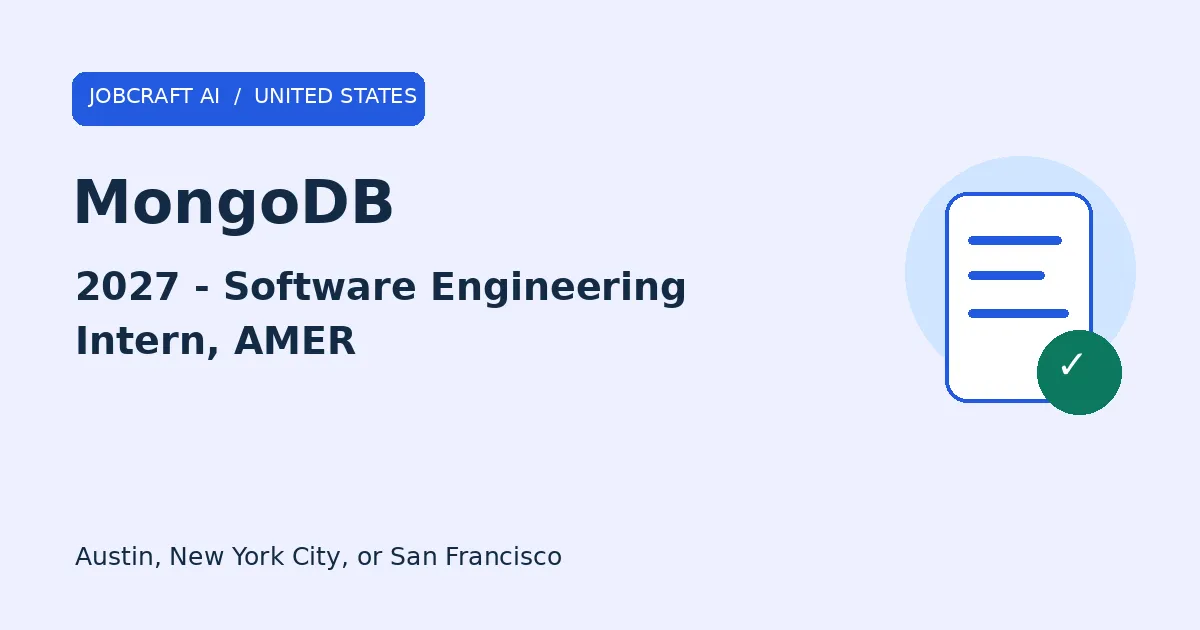
Location: Austin, New York City, or San Francisco. Employer listing checked: November 14, 2026.
MongoDB’s 2027 software engineering internship listing covers Austin, New York City, and San Francisco. It describes a 12-week program beginning in May or June, with full-time work and a hybrid office expectation. Read the employer’s graduation windows, requirement for a term remaining after the internship, and US work authorization requirement before preparing your application.
Pick one engineering project you can explain deeply
The posting values computer science fundamentals and fluency in one language, with examples including Java, Python, Go, C++, and JavaScript. You can demonstrate those skills with a course project, an open-source contribution, or a small application you actually built. Choose one where you understand the code beyond its public interface.
Start with what the program needed to do. Explain the inputs, the output, and a design constraint. Then describe why you used a particular data structure or interface. If you used a map to look up records, explain what key you chose and what happens when two inputs produce the same key. Specific examples make fundamentals concrete.
Create a testable engineering story
A small project is enough if you can show a meaningful defect you discovered and fixed. Include the failure case, the test or reproduction steps, and what changed in the implementation. If the fix required trading memory for speed, describe where that trade-off mattered and where it would not have made a noticeable difference.
Organize a repository so a reviewer can run it. Include dependencies, sample input, and one command for tests, using only files you can share. A README can explain the features that are complete and the limitations you know about. Make sure there are no personal credentials, private datasets, or internal code in any link you submit.
Rehearse coding fundamentals
Take a small problem such as grouping events by user and keeping the latest event for each group. Ask how timestamps are represented, whether duplicates matter, and what should happen with missing data. Choose a data structure, explain the time and space complexity, and test simple and edge cases by hand.
Then extend it. Suppose the event stream no longer fits in memory. Describe what changes if you can partition the input, use persistent storage, or only need approximate results. You do not need to design a globally distributed system to answer well. The useful part is explaining which constraint invalidates your first approach.
Make eligibility visible without oversharing
Include your degree program and expected graduation date in your résumé. The listing spells out eligible dates and expects at least one term of studies remaining. Use the application form for the employer’s questions about eligibility and location. In your resume, focus on programming languages, testing, software design, and collaboration that a reviewer can connect to your projects.
Build an application around evidence the reader can verify
Start with a programming project where input size or edge cases changed the design. Draft three sentences before writing a résumé bullet. The first explains the problem in language a colleague outside your team would understand. The second states the decision you owned and why you chose it. The third gives the result and identifies what you know firsthand. If the outcome came from several people, say which part you can explain in detail. This exercise helps turn a broad claim into evidence you can discuss if the employer asks follow-up questions.
For this opening, consider preparing a readable repository with a small runnable example and a focused test suite. You may use it to organize your interview answer even if you never send it. Include only information you are allowed to share. Replacing company names is insufficient if a chart or a unique deal detail still identifies the organization. A reconstructed example with synthetic data can show the process if you label it clearly and avoid presenting its figures as a past result. Give each entry a short caption that explains the decision it supported.
Review your story against input assumptions, time complexity, memory use, and regression cases. Decide which facts are essential to understanding the work and which are background. A useful test is to describe your role in one minute, then ask someone to repeat back the problem, your contribution, and the outcome. Revise any part they cannot follow. After that, prepare a longer version that makes room for constraints and trade-offs without obscuring the main point.
Interview practice with a role-specific prompt
Practice question: How would you adapt your solution if the input grew beyond available memory?
A sample service imports timestamped records and sends a summary by user. Two records have identical timestamps and some records are malformed. Write down the resolution rule and the expected behavior for invalid input. Explain how your choices affect reproducibility; the same dataset should not produce a different report simply because record order changed.
Build a second answer from your own work or studies. A useful starting point is a situation where your first implementation never handled duplicate or out-of-order events. Explain what made the situation difficult and what information you had at the time. Then describe your reasoning, including whether an action like specifying the expected behavior and adjusting the data structure or test coverage would have made sense. If you made a different choice, explain the constraints. The goal is to show how you evaluate alternatives, make a decision, and learn from the result. A mixed outcome can be useful if you can account for it honestly.
To prepare follow-ups, review the failing test, the revised implementation, and documentation on how to rerun it. Think about what each piece would verify. Interviewers can ask how you established the baseline, what happened when an assumption changed, or how you knew the project worked. If you do not have reliable numbers, identify something observable you can explain, such as a completed handoff, a passed test, or a change in the expected workflow. Keep a clear distinction between the facts you observed and the conclusions you drew from them.
Decide whether the opening fits your priorities
One question to ask the employer is: “How do mentors help interns break a production contribution into reviewable changes?” Listen for an answer that gives examples, such as the first assignment, the people who will review your work, or the outcomes measured during onboarding. Make a note of anything the listing leaves open about location, work arrangements, availability, or the scope of the position. A written requirement on the official posting deserves more weight than an assumption based on the title alone.
Before submitting, read through the application as if you were the reviewer. Put the most relevant evidence where it can be found quickly. Check that job titles and dates agree across your résumé and application, that every link works without credentials, and that the selected draft names MongoDB correctly. Use the JobCraft AI résumé checker to review your document against the full posting, then make edits based on work you can demonstrate.
Official listing and application
Confirm the opening is still listed and follow the employer’s submission instructions. View the job and apply through MongoDB