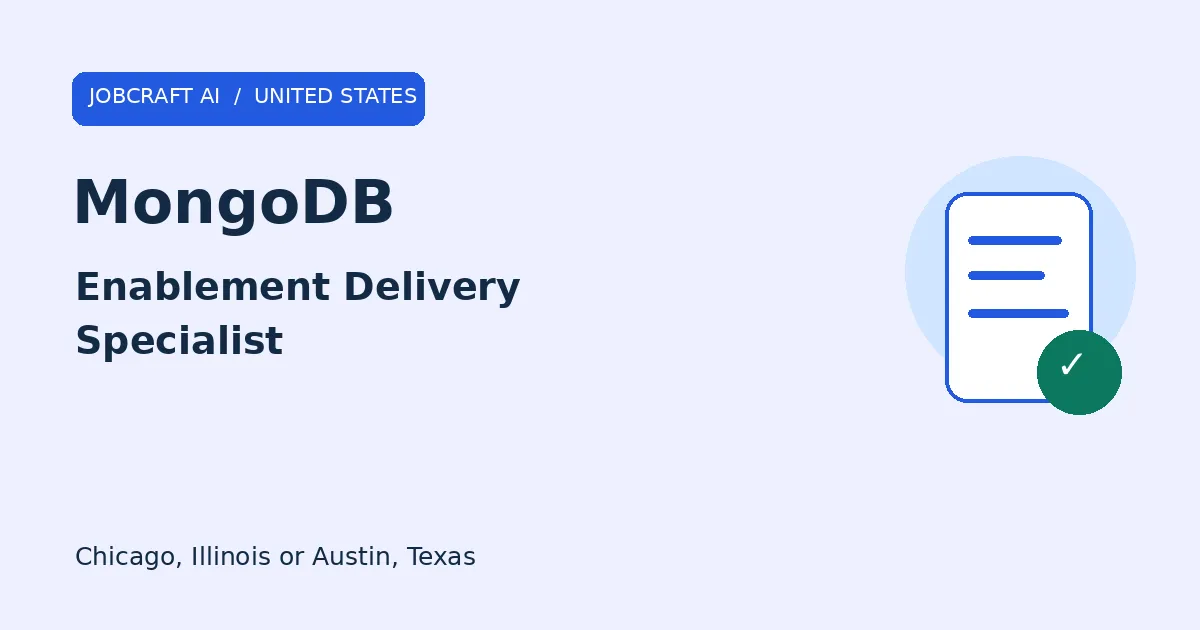
Location: Chicago, Illinois or Austin, Texas. Employer listing checked: November 14, 2026.
MongoDB’s Enablement Delivery Specialist opening is listed for Chicago or Austin. Its description offers a hybrid path in Chicago and asks Austin-based candidates to be able to travel to Chicago for one week per month. The position produces and hosts training events for the go-to-market organization, coordinates facilitators and vendors, and uses learner feedback to improve delivery.
Show how you run a live training session
A strong producer knows what should happen at each point in a session and who takes over if it does not. Prepare a sample run of show with facilitator handoffs, technical checks, activity timings, and breaks. Identify which activities can shift if the first speaker runs long. A clear delivery plan lets the facilitator focus on the learners while someone else manages timing and logistics.
Tell a story about a session that hit a snag. Explain what participants experienced, what you told the facilitator, and how you adjusted without losing sight of the learning objective. For an in-person event, the issue might involve room layout or equipment. For a virtual session, it might involve breakout assignments or speaker access. A useful story explains both your immediate response and the change you made before the next event.
Organize learner and facilitator information
Invitations, calendars, attendance, and surveys can disagree if responsibilities are unclear. Decide who owns each record and what happens when a participant changes cohorts. Document the checks you would run before sharing attendance data. If the role involves multiple event types, consider which parts of the workflow can follow a shared checklist and which need a separate plan.
Rehearse what to do if a facilitator needs support in the middle of an activity. Use a private communication channel for instructions where possible and keep participants informed about any timing change they need to know. Explain what you would record afterward for the content designer or delivery lead.
Turn feedback into a specific change
Participants may give a strong satisfaction rating but report confusion around the same exercise. Group feedback by activity and compare it with what facilitators observed. Suggest a change that addresses the issue, such as adding an example before breakout work. Decide how you would check whether the next group understood the task more quickly. This makes feedback useful to the content design team.
A résumé can describe event volume, participant groups, and platforms such as Zoom or an LMS if they reflect your experience. Explain the work you owned: scheduling, vendor coordination, facilitation, tracking, or feedback analysis. If your background is outside sales enablement, link transferable examples to training delivery without recasting unrelated duties as direct experience.
What to bring to your application
Start with a training event where you handled logistics and an unexpected change. Draft three sentences before writing a résumé bullet. The first explains the problem in language a colleague outside your team would understand. The second states the decision you owned and why you chose it. The third gives the result and identifies what you know firsthand. If the outcome came from several people, say which part you can explain in detail. This exercise helps turn a broad claim into evidence you can discuss if the employer asks follow-up questions.
For this opening, consider preparing a run of show with owners, timing, and a fallback for technology problems. You may use it to organize your interview answer even if you never send it. Include only information you are allowed to share. Replacing company names is insufficient if a chart or a unique deal detail still identifies the organization. A reconstructed example with synthetic data can show the process if you label it clearly and avoid presenting its figures as a past result. Give each entry a short caption that explains the decision it supported.
A practice question for this opening
Practice question: How would you recover if a live training activity fails halfway through?
A trainer loses connection just as a live workshop moves into practice. Identify what information learners need immediately, who should establish contact with the facilitator, and how you would keep the activity useful during the interruption. After the workshop, distinguish changes for the producer from changes for the content designer. Use the feedback to propose a narrower improvement that can be tested in the next session.
Build a second answer from your own work or studies. A useful starting point is a situation where learners lost time joining a breakout and the main exercise fell behind schedule. Explain what made the situation difficult and what information you had at the time. Then describe your reasoning, including whether an action like moving to a paired practice task aligned with the same learning goal would have made sense. If you made a different choice, explain the constraints. The goal is to show how you evaluate alternatives, make a decision, and learn from the result. A mixed outcome can be useful if you can account for it honestly.
To prepare follow-ups, review the session plan, attendance record, and feedback on the revised activity. Think about what each piece would verify. Interviewers can ask how you established the baseline, what happened when an assumption changed, or how you knew the project worked. If you do not have reliable numbers, identify something observable you can explain, such as a completed handoff, a passed test, or a change in the expected workflow. Keep a clear distinction between the facts you observed and the conclusions you drew from them.
What to clarify before applying
One question to ask the employer is: “What portion of this role is facilitation compared with program production?” Listen for an answer that gives examples, such as the first assignment, the people who will review your work, or the outcomes measured during onboarding. Make a note of anything the listing leaves open about location, work arrangements, availability, or the scope of the position. A written requirement on the official posting deserves more weight than an assumption based on the title alone.
Before submitting, read through the application as if you were the reviewer. Put the most relevant evidence where it can be found quickly. Check that job titles and dates agree across your résumé and application, that every link works without credentials, and that the selected draft names MongoDB correctly. Use the JobCraft AI résumé checker to review your document against the full posting, then make edits based on work you can demonstrate.
Official listing and application
Confirm the opening is still listed and follow the employer’s submission instructions. View the job and apply through MongoDB