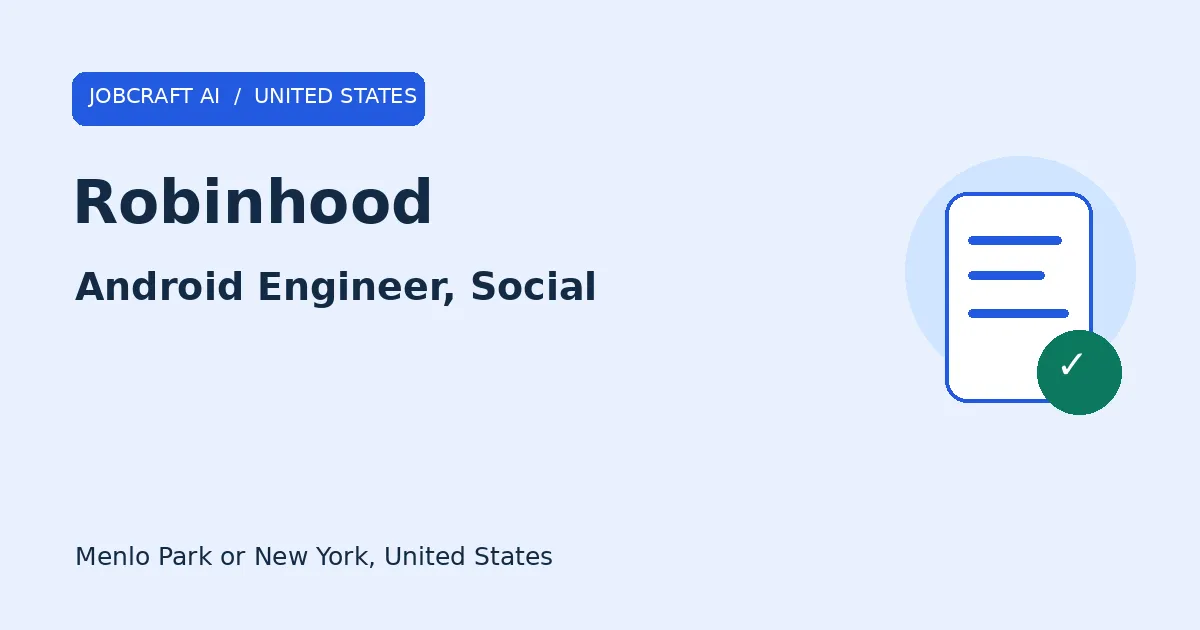
Location: Menlo Park or New York, United States. Employer listing checked: November 14, 2026.
Robinhood lists an Android Engineer, Social opening with Menlo Park and New York in the location field. The description specifically references New York team attendance of at least three days per week, so candidates should confirm the applicable office with the recruiter. The role builds Android features for social feeds, sharing, and onboarding and asks for at least three years of professional Android development. Kotlin, Jetpack Compose, and Android architecture components feature in the posting.
Discuss a real Android feature from start to finish
Choose a product feature where state changed for reasons beyond a tap on a screen. A feed, for instance, can show cached content while refreshing, display a recoverable error, or keep the user’s place when returning from a detail view. Explain how you modeled those states and what changed when the backend returned incomplete or delayed data. Give a precise description of your work, such as data loading, layout, test design, or rollout.
Prepare to discuss the product constraint as well as the code. If a design calls for immediate feedback, explain what can happen locally and when the app must wait for a response. Make it clear how the app communicates the status of an action. A screen can appear fast while hiding a failure, so choose measures that include both responsiveness and correctness.
Rehearse a Kotlin and Compose design discussion
Consider a screen with an initial load, pagination, and pull-to-refresh. Define the state rendered by the UI, how refresh interacts with cached content, and what happens when two requests finish out of order. Explain how you would test the state transitions separately from the composable layout. If you prefer a particular architecture, explain what maintenance benefit it brings and why it fits this example.
For a performance story, describe how you isolated slow drawing or a costly operation. Show what measurement established the baseline, what you changed, and whether behavior stayed correct. Name Compose, coroutines, or testing tools where they were part of your actual work. If your experience is with Java or an older Android stack, identify the directly relevant skills and present any Compose work accurately.
Show collaboration across product and engineering
Pick an example where Android behavior depended on a backend or web decision. Explain how the teams agreed on the contract, handled a partial rollout, and documented what would happen if old and new clients saw different responses. Describe when design or data partners changed your understanding of the result. Strong feature ownership includes keeping the right people informed after launch, not just handing off a merged change.
What to bring to your application
Start with an Android feature that needed predictable UI behavior with slow or variable responses. Draft three sentences before writing a résumé bullet. The first explains the problem in language a colleague outside your team would understand. The second states the decision you owned and why you chose it. The third gives the result and identifies what you know firsthand. If the outcome came from several people, say which part you can explain in detail. This exercise helps turn a broad claim into evidence you can discuss if the employer asks follow-up questions.
For this opening, consider preparing a short screen-state diagram with success, loading, and error transitions. You may use it to organize your interview answer even if you never send it. Include only information you are allowed to share. Replacing company names is insufficient if a chart or a unique deal detail still identifies the organization. A reconstructed example with synthetic data can show the process if you label it clearly and avoid presenting its figures as a past result. Give each entry a short caption that explains the decision it supported.
A practice question for this opening
Practice question: How would you keep a social feed usable while it refreshes?
A refreshed feed has new items at the top while the user is reading an older item. Decide when to update the collection and how to preserve position. Include one case where pagination returns a duplicate item. Explain which assertions belong in a state test and which require rendering or accessibility checks. Keep the example focused on the experience the user sees rather than defending a particular architecture by name.
Build a second answer from your own work or studies. A useful starting point is a situation where some updates were arriving after the user moved to a different item. Explain what made the situation difficult and what information you had at the time. Then describe your reasoning, including whether an action like scoping requests to current state and testing stale responses separately from rendering would have made sense. If you made a different choice, explain the constraints. The goal is to show how you evaluate alternatives, make a decision, and learn from the result. A mixed outcome can be useful if you can account for it honestly.
To prepare follow-ups, review the state tests, release notes, and a post-launch observation. Think about what each piece would verify. Interviewers can ask how you established the baseline, what happened when an assumption changed, or how you knew the project worked. If you do not have reliable numbers, identify something observable you can explain, such as a completed handoff, a passed test, or a change in the expected workflow. Keep a clear distinction between the facts you observed and the conclusions you drew from them.
What to clarify before applying
One question to ask the employer is: “Which user flows will this engineer own first, and which office applies to the opening?” Listen for an answer that gives examples, such as the first assignment, the people who will review your work, or the outcomes measured during onboarding. Make a note of anything the listing leaves open about location, work arrangements, availability, or the scope of the position. A written requirement on the official posting deserves more weight than an assumption based on the title alone.
Before submitting, read through the application as if you were the reviewer. Put the most relevant evidence where it can be found quickly. Check that job titles and dates agree across your résumé and application, that every link works without credentials, and that the selected draft names Robinhood correctly. Use the JobCraft AI résumé checker to review your document against the full posting, then make edits based on work you can demonstrate.
Official listing and application
Confirm the opening is still listed and follow the employer’s submission instructions. View the job and apply through Robinhood