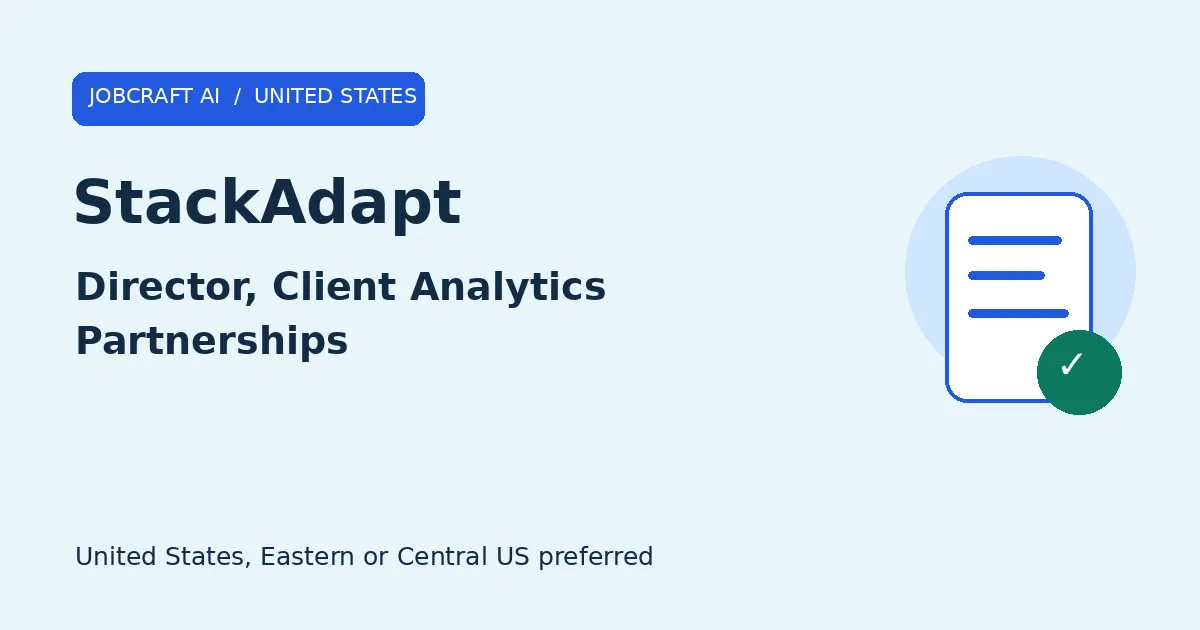
Location: United States, Eastern or Central US preferred. Employer listing checked: November 14, 2026.
StackAdapt’s Director, Client Analytics Partnerships opening is listed in the United States. The employer describes remote-first work with priority for candidates in the Eastern or Central US to support in-person client collaboration. The role develops a team that advises clients on measurement, experimentation, and decision-making across advertising campaigns and industries.
Define the question before choosing a measure
A client may ask whether a campaign worked. Start by asking what decision the answer will inform. The measurement approach changes if the client is choosing between channels, evaluating the impact of a message, or deciding which audience to reach next. Explain which outcome the stakeholders care about and what evidence would be strong enough to change their decision.
A director-level case study should show how you made this process repeatable across engagements. Describe the questions you taught team members to ask at kickoff, the standards for documenting assumptions, and the escalation path when a client request needs additional evidence. Show how the approach accommodated different business models rather than forcing every client into the same reporting view.
Demonstrate experimental judgment
Prepare a campaign example where attribution and incremental effect were separate questions. Explain what each method could establish, what it could miss, and how you would design a feasible test. Before comparing two audiences, consider sample size, comparability, and whether campaign exposure can overlap. A client may need a directional answer earlier than ideal; be prepared to explain what decisions such evidence can support and what remains uncertain.
Discuss how you translated findings into a recommendation that a senior decision-maker could use. A concise briefing separates the outcome, the caveats, and the next action. Back it up with an appendix about data definitions and checks. If you need to simplify a technical point, keep the uncertainty visible rather than implying precision you cannot defend.
Show how you build analytical capability
The job posting expects coaching and cross-functional influence. Prepare a story about helping a team move from reporting past results to advising on future actions. Describe how you reviewed the work, helped team members ask better questions, and gave them room to lead client conversations. Explain how the practice got stronger after an engagement ended: clearer guidance, better measurement tools, or a product insight shared with another team.
In a résumé, pair strategic measurement, experimentation, and executive advisory with examples of the decisions they informed. Make clear what you led and what technical analysis was completed by specialists. If you have worked across several sectors, illustrate how you changed the approach for each rather than listing the sectors alone.
What to bring to your application
Start with a client engagement where an experiment changed an investment decision. Draft three sentences before writing a résumé bullet. The first explains the problem in language a colleague outside your team would understand. The second states the decision you owned and why you chose it. The third gives the result and identifies what you know firsthand. If the outcome came from several people, say which part you can explain in detail. This exercise helps turn a broad claim into evidence you can discuss if the employer asks follow-up questions.
For this opening, consider preparing a measurement plan with assumptions, business outcomes, and decision rules. You may use it to organize your interview answer even if you never send it. Include only information you are allowed to share. Replacing company names is insufficient if a chart or a unique deal detail still identifies the organization. A reconstructed example with synthetic data can show the process if you label it clearly and avoid presenting its figures as a past result. Give each entry a short caption that explains the decision it supported.
A practice question for this opening
Practice question: How would you help a client decide what to test before a campaign launches?
A commerce client wants to use a conversion dashboard to justify a larger campaign budget. Separate the question of which events were attributed from the question of what would have happened without the campaign. Suggest a credible comparison and explain the cost and timing implications. If the evidence remains inconclusive, identify an intermediate decision the client can make while the team collects better data.
Build a second answer from your own work or studies. A useful starting point is a situation where an executive needed a decision before the ideal experiment could finish. Explain what made the situation difficult and what information you had at the time. Then describe your reasoning, including whether an action like presenting a directional recommendation and preserving a stronger test for the longer-term choice would have made sense. If you made a different choice, explain the constraints. The goal is to show how you evaluate alternatives, make a decision, and learn from the result. A mixed outcome can be useful if you can account for it honestly.
To prepare follow-ups, review the original brief, test assumptions, and the record of the decision. Think about what each piece would verify. Interviewers can ask how you established the baseline, what happened when an assumption changed, or how you knew the project worked. If you do not have reliable numbers, identify something observable you can explain, such as a completed handoff, a passed test, or a change in the expected workflow. Keep a clear distinction between the facts you observed and the conclusions you drew from them.
What to clarify before applying
One question to ask the employer is: “How does the team balance client advisory work with developing reusable measurement frameworks?” Listen for an answer that gives examples, such as the first assignment, the people who will review your work, or the outcomes measured during onboarding. Make a note of anything the listing leaves open about location, work arrangements, availability, or the scope of the position. A written requirement on the official posting deserves more weight than an assumption based on the title alone.
Before submitting, read through the application as if you were the reviewer. Put the most relevant evidence where it can be found quickly. Check that job titles and dates agree across your résumé and application, that every link works without credentials, and that the selected draft names StackAdapt correctly. Use the JobCraft AI résumé checker to review your document against the full posting, then make edits based on work you can demonstrate.
Official listing and application
Confirm the opening is still listed and follow the employer’s submission instructions. View the job and apply through StackAdapt