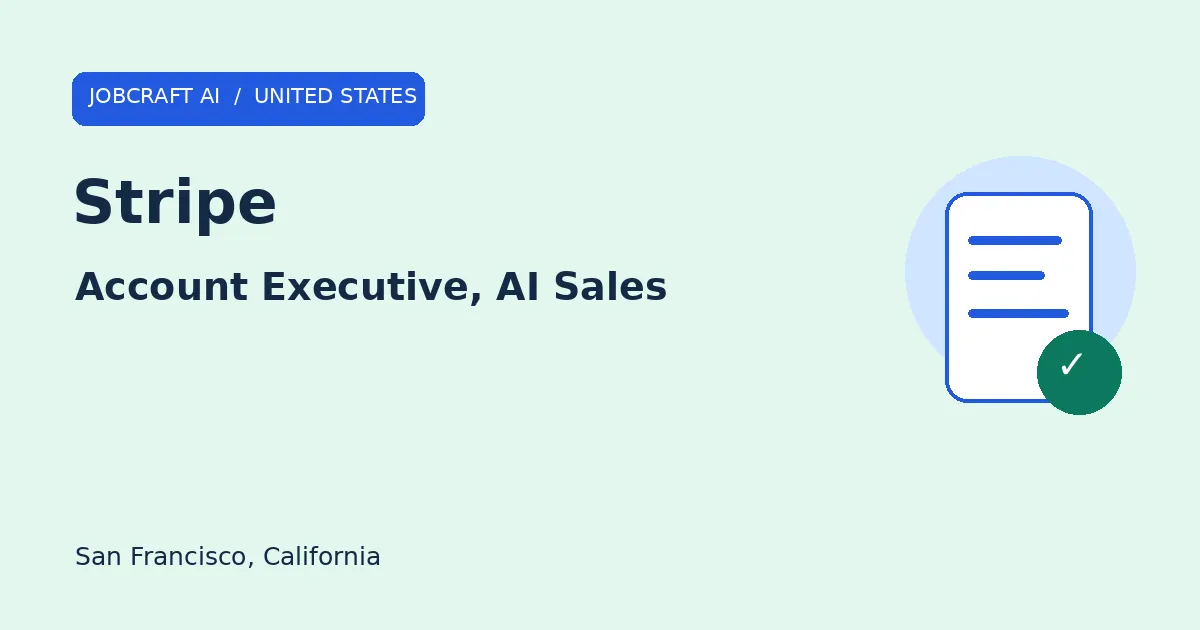
Location: San Francisco, California. Employer listing checked: November 14, 2026.
Stripe is recruiting an Account Executive, AI Sales in San Francisco. The posting focuses on expanding relationships with existing AI customers, structuring complex renewals, and developing account plans that span several business units. It lists eight or more years in sales and at least two years leading complex sales cycles with AI-native or enterprise organizations. This opening concerns commercial leadership for technical customers, with responsibility from business-case development to closing.
Show the link between a technical requirement and a commercial proposal
A buyer might be launching a new product that charges by subscription, usage, or a combination of the two. Each model produces different questions for product, engineering, and finance. A strong account executive establishes who owns pricing, where billing data comes from, and how the customer recognizes a successful launch. Show how you turned those questions into a plan a buyer could evaluate. The proposal should make clear which dependency the customer must resolve before a date or volume estimate makes sense.
A persuasive résumé example names the actual complexity. Maybe the deal covered several markets, involved multiple product lines, or required agreement across operating units. Explain which group had the budget, which group could stop implementation, and where you helped them agree. Distinguish your commercial contribution from the technical work performed by product specialists or engineers. That distinction makes the example stronger because it shows how you use partners without claiming their work.
Prepare an account map that reflects how decisions are made
Draw three columns for business outcomes, technical readiness, and commercial approval. For each column, list the relevant stakeholder and one unresolved question. Prepare a short explanation of how you would keep the customer’s teams informed if the renewal were progressing faster than the new product rollout. A forecast should show those as separate milestones so interest in the expansion does not obscure uncertainty around delivery.
For review, compare two scenarios: a renewal with existing scope and a renewal plus a phased expansion. Describe the value, commitments, and risk in each. Rather than promising a concession ahead of discovery, explain what information you would need to make a recommendation and which terms require approval. Tell the story as a decision that the customer and your organization could both understand.
Rehearse a pricing and negotiation conversation
Imagine a buyer wants to sign this quarter but expects usage to vary significantly after launch. Ask what drives the range and whether a pilot can narrow it. Describe how you would communicate the effect of slower or faster adoption on the plan. Explain the trade-off between simplicity for the buyer and the flexibility needed for growth. This is a practice exercise, not a description of Stripe’s interview process.
What to bring to your application
Start with a negotiation for a technical customer with multiple approval teams. Draft three sentences before writing a résumé bullet. The first explains the problem in language a colleague outside your team would understand. The second states the decision you owned and why you chose it. The third gives the result and identifies what you know firsthand. If the outcome came from several people, say which part you can explain in detail. This exercise helps turn a broad claim into evidence you can discuss if the employer asks follow-up questions.
For this opening, consider preparing a short deal brief that separates the base renewal from new product scope. You may use it to organize your interview answer even if you never send it. Include only information you are allowed to share. Replacing company names is insufficient if a chart or a unique deal detail still identifies the organization. A reconstructed example with synthetic data can show the process if you label it clearly and avoid presenting its figures as a past result. Give each entry a short caption that explains the decision it supported.
A practice question for this opening
Practice question: How would you turn an AI customer’s pricing change into a measurable account plan?
A customer wants to move a new product to usage-based billing. The buyer is confident about the launch date, but nobody has agreed on how to forecast usage. Draw a small table showing who owns usage data, what minimum evidence is needed, and which assumptions should stay open. In a practice answer, state how those uncertainties affect implementation sequencing and the commercial conversation. End by identifying one commitment you could request before proposing final terms.
Build a second answer from your own work or studies. A useful starting point is a situation where leaders agreed on the value but product teams disagreed about launch timing. Explain what made the situation difficult and what information you had at the time. Then describe your reasoning, including whether an action like separating near-term renewal commitments from a pilot with a defined success measure would have made sense. If you made a different choice, explain the constraints. The goal is to show how you evaluate alternatives, make a decision, and learn from the result. A mixed outcome can be useful if you can account for it honestly.
To prepare follow-ups, review your decision summary, deal stages, and customer commitments. Think about what each piece would verify. Interviewers can ask how you established the baseline, what happened when an assumption changed, or how you knew the project worked. If you do not have reliable numbers, identify something observable you can explain, such as a completed handoff, a passed test, or a change in the expected workflow. Keep a clear distinction between the facts you observed and the conclusions you drew from them.
What to clarify before applying
One question to ask the employer is: “How does this sales team partner with product specialists on usage-based billing conversations?” Listen for an answer that gives examples, such as the first assignment, the people who will review your work, or the outcomes measured during onboarding. Make a note of anything the listing leaves open about location, work arrangements, availability, or the scope of the position. A written requirement on the official posting deserves more weight than an assumption based on the title alone.
Before submitting, read through the application as if you were the reviewer. Put the most relevant evidence where it can be found quickly. Check that job titles and dates agree across your résumé and application, that every link works without credentials, and that the selected draft names Stripe correctly. Use the JobCraft AI résumé checker to review your document against the full posting, then make edits based on work you can demonstrate.
Official listing and application
Confirm the opening is still listed and follow the employer’s submission instructions. View the job and apply through Stripe