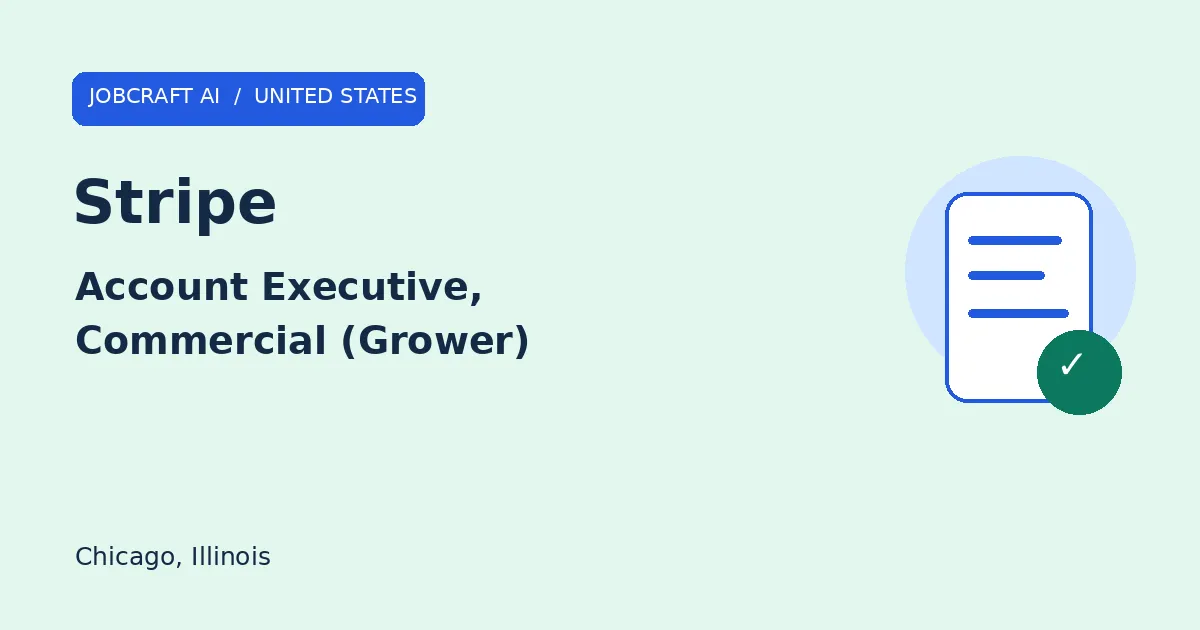
Location: Chicago, Illinois. Employer listing checked: November 14, 2026.
Stripe’s Chicago commercial sales opening is for an account executive who grows existing mid-market accounts. The employer lists at least five years of closing experience with existing customers and three days per week in the Chicago office. The work covers renewals, negotiations, and selling additional products when they address a customer’s needs. Experience at a high-growth payments company is listed as preferred.
What commercial growth looks like here
A renewal discussion can reveal a problem that has little to do with price. A customer may have expanded to a new market, added a sales channel, or inherited a payment process that creates manual work for finance. A useful discovery conversation establishes what changed, how the customer measures the impact, and who will judge whether fixing it is worth doing. That makes the commercial proposal easier to evaluate than a list of product features.
The posting also describes managing a book of roughly 100 accounts. An application should show how you handled competing demands across a portfolio. Explain which signals prompted a live conversation, which accounts were better served by scaled outreach, and where you deliberately waited. A clean segmentation story helps show how you handle volume without treating every customer as interchangeable.
Build a credible renewal example
Pick one account where the result depended on coordinating several buyer groups. Start with the commercial baseline. Describe the renewal date, the customer objective and the commitments already in place, using generalized numbers if necessary. Then explain what you owned personally. Perhaps you clarified technical dependencies, brought in a specialist, or turned a broad pricing objection into a discussion about rollout timing. Finish with the outcome you can verify, whether that was a retained contract, a staged rollout, or a decision against adding scope.
For an expansion example, show how you separated commercial upside from implementation risk. Readiness may depend on a technical champion, available engineering time, or agreement on the first country or product to roll out. Explain how you handled those constraints in the forecast. A buyer’s positive feedback is useful context; an agreed date and a named owner are stronger evidence that a deal can move.
Practice a Chicago sales interview scenario
Suppose a long-time customer plans to renegotiate and asks for a discount before discussing its next year of growth. A prepared answer identifies what is driving the request, what usage information you would review, and who is involved in the decision. Outline one option that keeps scope stable and one that changes the rollout or commitment. Explain what you would ask your internal team to approve and how you would document the trade-off afterward.
Expect to discuss quantitative judgment. You might rehearse showing the same expansion in three ways: projected volume, expected customer benefit, and sensitivity to a slower launch. An account plan earns credibility when the numbers and assumptions are visible and when the team knows what evidence would change its forecast.
Show evidence in your résumé
Useful phrases from the posting include commercial renewals, account expansion, pricing negotiations, and full sales cycle. Pair each term with a real example. If you carried a renewal book, describe the customer segment and the cadence you used. If you partnered with technical teams, name the problem they helped solve without presenting yourself as the person who built the integration. Use retention or revenue figures only if you can explain the denominator and period.
Build an application around evidence the reader can verify
Start with a renewal where product adoption was below plan. Draft three sentences before writing a résumé bullet. The first explains the problem in language a colleague outside your team would understand. The second states the decision you owned and why you chose it. The third gives the result and identifies what you know firsthand. If the outcome came from several people, say which part you can explain in detail. This exercise helps turn a broad claim into evidence you can discuss if the employer asks follow-up questions.
For this opening, consider preparing a one-page account plan breaking the portfolio into renewal risk, adoption potential, and timing. You may use it to organize your interview answer even if you never send it. Include only information you are allowed to share. Replacing company names is insufficient if a chart or a unique deal detail still identifies the organization. A reconstructed example with synthetic data can show the process if you label it clearly and avoid presenting its figures as a past result. Give each entry a short caption that explains the decision it supported.
Review your story against renewal date, decision-maker access, measured product usage, and open technical issues. Decide which facts are essential to understanding the work and which are background. A useful test is to describe your role in one minute, then ask someone to repeat back the problem, your contribution, and the outcome. Revise any part they cannot follow. After that, prepare a longer version that makes room for constraints and trade-offs without obscuring the main point.
Interview practice with a role-specific prompt
Practice question: Which signals indicate that a customer could benefit from an additional payment product?
A seller inherits 100 accounts with no consistent health scores. Decide which accounts should receive a live call first. Use renewal date as one input, alongside the size of the known adoption gap and whether any open issue puts the relationship at risk. A simple weekly exception list can be more defensible than a complicated score built from incomplete data.
Build a second answer from your own work or studies. A useful starting point is a situation where you discovered interest was high but customer engineering time was scarce. Explain what made the situation difficult and what information you had at the time. Then describe your reasoning, including whether an action like arguing for a phased launch with a named customer owner and a review date would have made sense. If you made a different choice, explain the constraints. The goal is to show how you evaluate alternatives, make a decision, and learn from the result. A mixed outcome can be useful if you can account for it honestly.
To prepare follow-ups, review discovery notes, the pricing approval, and a follow-up showing whether adoption increased. Think about what each piece would verify. Interviewers can ask how you established the baseline, what happened when an assumption changed, or how you knew the project worked. If you do not have reliable numbers, identify something observable you can explain, such as a completed handoff, a passed test, or a change in the expected workflow. Keep a clear distinction between the facts you observed and the conclusions you drew from them.
Decide whether the opening fits your priorities
One question to ask the employer is: “How are expansion targets balanced with renewals across the Chicago team?” Listen for an answer that gives examples, such as the first assignment, the people who will review your work, or the outcomes measured during onboarding. Make a note of anything the listing leaves open about location, work arrangements, availability, or the scope of the position. A written requirement on the official posting deserves more weight than an assumption based on the title alone.
Before submitting, read through the application as if you were the reviewer. Put the most relevant evidence where it can be found quickly. Check that job titles and dates agree across your résumé and application, that every link works without credentials, and that the selected draft names Stripe correctly. Use the JobCraft AI résumé checker to review your document against the full posting, then make edits based on work you can demonstrate.
Official listing and application
Confirm the opening is still listed and follow the employer’s submission instructions. View the job and apply through Stripe